
5 Techniques You Can Try TONIGHT To Get Back To Sleep
For many people, the hardest part of the day isn’t the day at all.

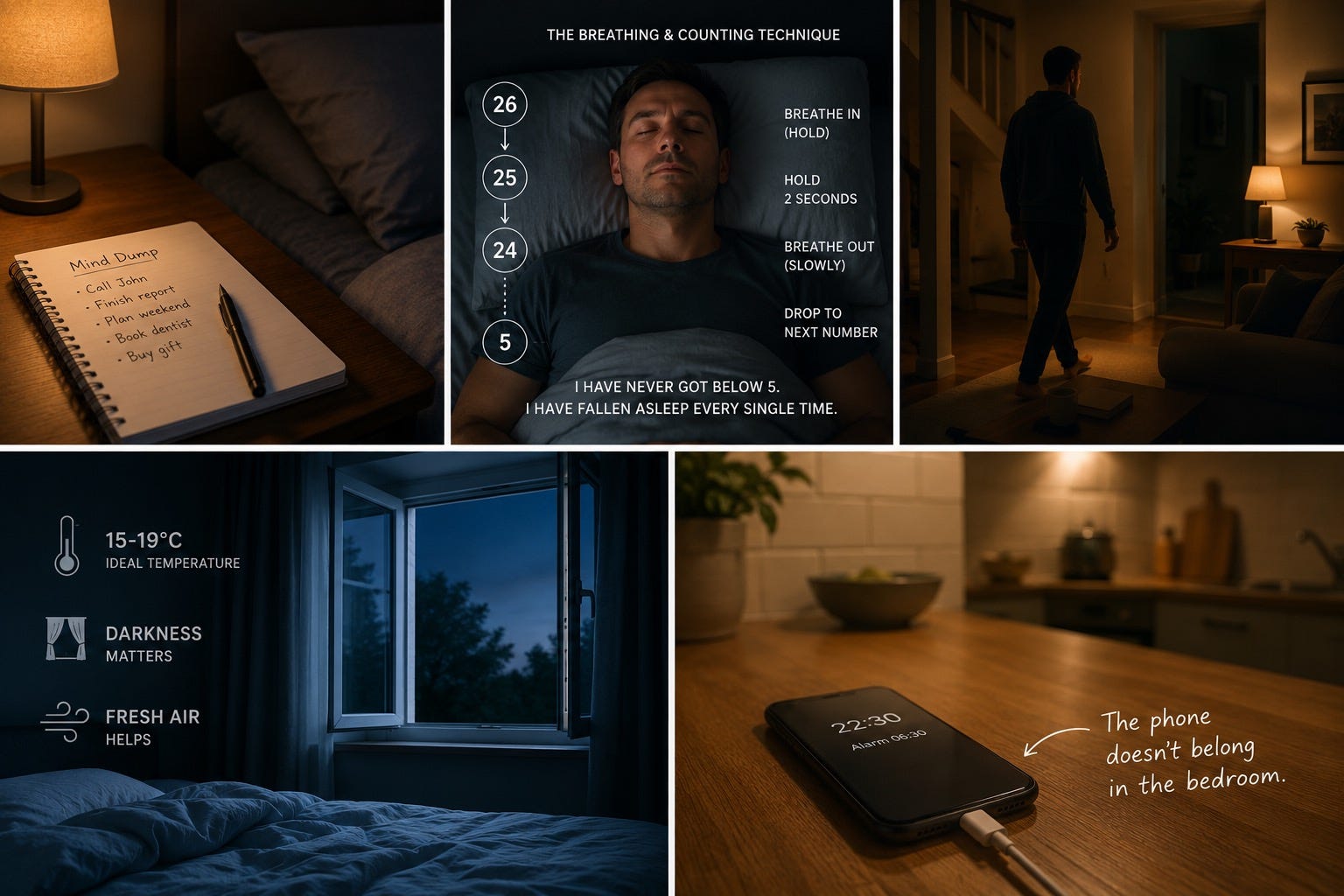
For many people, the hardest part of the day isn’t the day at all.
It’s the moment the lights go out. That’s when the unfinished business arrives. The thing you said wrong in a meeting. The problem you haven’t solved. The decision you’re not sure about. The list you haven’t finished. It all surfaces in the dark, and the harder you push it away, the louder it gets.
Actually, for me I’m fine actually going to sleep when my head hits the pillow. The problem arrises if I wake between 2am and 5 am. That’s the danger zone for me.
“The knock-on effects of lost sleep compound quickly.”
A problem that was manageable at 4pm feels insurmountable at 3am. Work tasks that usually sit well within your abilities suddenly feel out of reach. Small things start to feel like big things. And if it happens night after night, a downward spiral can begin that is genuinely hard to escape.
I came across a quote a while back:
“There are hundreds of ways to deal with stress and anxiety. All you need to do is find one that works.”
The same applies to sleep. You don’t need to solve everything. You just need to find one thing that gives you enough space to sleep, so that you can wake up and face things from a better place.
What follows is a collection of things that work for me. Not all of them will work for you. But something here might.
In this post I cover:
The Countdown Method
The Notebook
Getting out of the room
The Environment
Your Phone!
The Countdown method
About eighteen months ago, I discovered a breathing and counting technique that has, gradually, become something of a personal superpower.
Here’s how it works:
Get into your normal sleep position.
Place the number 26 in your mind.
Take a slow, deep breath in, holding the number in your head.
Hold your breath for two seconds.
Then breathe out, slowly.
When you’ve breathed out fully, drop to 25.
Breathe in again.
Hold.
Breathe out.
Then 24.
Repeat, going down one number at a time.
If your mind wanders back to your worry list (and it will), just notice it and bring yourself back to whatever number you’re supposed to be on. That part takes a bit of practice. But you get the feel for it quickly.
I have never got below 5. I have fallen asleep every single time, and I have never once been able to remember which number I drifted off on.
You might want to ask “why 26?”. Well, sometimes more random numbers are easier to remember. Nothing more scientific than that I’m afraid.
Why does this work?
There is a reason this works, and it goes beyond relaxation. When you pair slow, controlled breathing with a simple counting task, two things happen simultaneously. Physiologically, deep breathing activates the parasympathetic nervous system which directly counters the fight-or-flight response keeping you awake. The brain is, at its core, a pattern-recognition machine. When you give it a pattern to follow, it pays attention, and this immediately calms the central nervous system.
Cognitively, the counting acts as what researchers call an anchor. Focused attention on breathing activates the prefrontal cortex while calming the amygdala, the brain’s alarm centre. Your anxious thoughts aren’t suppressed exactly; they’re simply crowded out by something else. Something simple. Something that requires just enough attention to prevent your mind from spiralling, but not so much that it keeps you awake.
That’s the elegant part. The technique demands concentration, but not effort.
The notebook by the bed
Sometimes the reason you can’t sleep isn’t formless anxiety. It’s that you have too many actual thoughts. Things you’re afraid you’ll forget. Tasks you need to remember. Things unsaid. Your brain is trying to hold on to them, because it doesn’t trust that they’ll still be there in the morning.
The solution is simple: a notebook and pencil by the bed.
Write it down. Get it out of your head and onto the page. Once it’s there, your mind knows it’s safe. It doesn’t need to keep cycling through the thought. You can let it go.
There’s something else worth saying here. The things that feel enormous at 1am rarely feel the same at 7am. Morning is a better time to deal with most problems. You’re rested, you have perspective, and the notebook is there waiting for you with everything written down. That cycle of offloading at night and processing in the morning becomes a genuinely useful habit over time.
Leave the room
If you’ve been lying awake for a while and the techniques aren’t landing, try this: get up.
Go downstairs.
Walk around.
Tidy something small.
Then come back to bed.
This sounds counterintuitive, but it works as a reset. You’re breaking the association between lying in bed and feeling frustrated. When you return, you’re starting fresh.
The environment
Before you even get into bed, your bedroom is either working for you or against you.
Temperature is the most underrated factor when trying to sleep.
Most sleep experts agree that the optimal room temperature is between 15 and 19 degrees Celsius. The reason is physiological: about two hours before bedtime, the body naturally begins to cool down, signalling that it’s time to sleep. A warm room fights against this process. A cool room supports it. If you can sleep with a window open and let fresh air move through the room, that’s better still.
We’ve trained ourselves into this over the years. It felt strange at first. Now it’s just how we sleep.
Darkness matters too. At this time of year in the UK, dawn can arrive before 4am in some parts of the country.
Blackout curtains are not a luxury. They’re just sense.
The phone doesn’t belong in the bedroom
This one I feel strongly about.
My phone charges overnight in the kitchen. Not on my bedside table. Not face-down on the floor. In the kitchen, out of the room, out of reach. If I need an alarm, I use an alarm clock designed for that purpose.
“Big tech didn’t put an alarm clock on your phone because they’re nice! They want holding their phone the first thing you do every day!"
This means I’m not tempted to scroll before bed. It means I can read instead, which is a far better way to settle the mind. And it means that when I wake up in the morning, the first thing I do is get up and go downstairs which is a genuinely better way to start the day, rather than lying in bed absorbing emails before I’ve even had a glass of water.
On that note: your water intake matters more than you might think. I’ve been working on drinking more consistently through the day roughly a pint every two hours. But the important rule is to stop drinking after 9pm. A full bladder an hour after you fall asleep is a reliable way to break any good sleep you’ve managed to build, and it’s entirely preventable.
More on water intake in a future post…..
One last thought
None of what I’ve written here is radical. A lot of it is straightforward, even obvious. But there’s a difference between knowing something and actually doing it consistently.
The night is the hardest part of the day for a lot of people. It doesn’t have to be. Pick one thing from this list. Try it for a week. See if it shifts anything.
You might be surprised which number you fall asleep on.
If you know someone who you think might benefit from this please feel free to forward on. I’ve added big red button to help you here. Thanks!
Here’s a good podcast to listen to this week….
In the week that social media has been labelled in the same danger category as smoking here’s a sobering discussion about what your phone is doing to your brain.
Enjoy - and have a great week!
Thank you, thank you, Martin ! you are a peach! I'd read your earlier post on this, and for some reason, forgot the details! But now I know them again and will again put into practice when the need arises. Also, what you say about problems seeming insurmountable in middle of the night, but reasonable or fixable in the daylight -- so very true! Thank you again!!!
https://polymarket.com/event/world-cup-winner
https://bigthinkmedia.substack.com/p/fix-your-destructive-mindset-in-15
https://minervaguzmanlopez.substack.com/p/coming-soon
https://bigthinkmedia.substack.com/p/fix-your-destructive-mindset-in-15
https://neverstoplearning1.substack.com/p/5-techniques-you-can-try-tonight
https://happyyoga.substack.com/p/5-minute-anxiety-reset-no-breath